Dry Eye Treatment
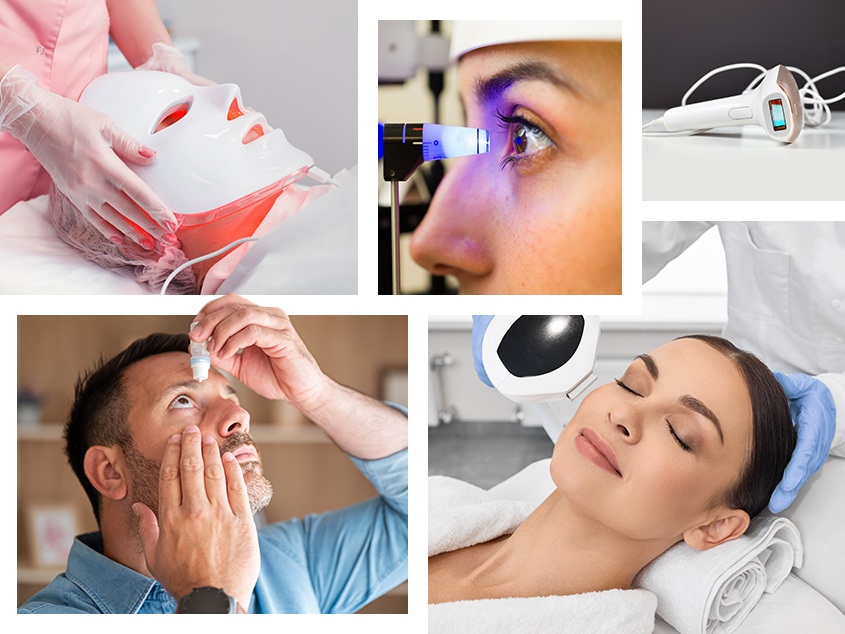
Dry Eye Care: More Than Just Eye Drops
Dry eye is a complex ocular surface condition that can have many contributing factors, including inadequate tear production, excessive tear evaporation, inflammation, and dysfunction of the meibomian glands—the tiny oil-producing glands in your eyelids that help keep tears from evaporating too quickly.
Because every patient’s dry eye is different, treatment should be tailored to the underlying cause rather than simply treating the symptoms. Depending on your individual needs, treatment may include lubricating or prescription eye drops, warm compresses, eyelid and lid-margin cleansing, meibomian gland therapy, punctal plugs, amniotic membrane therapy for more significant ocular surface disease, and advanced in-office treatments such as intense pulsed light (IPL).
Current dry-eye guidelines emphasize an individualized, stepwise approach because there is no single treatment that works for every patient. (TFOS DEWS Report)
IPL for Dry Eye & Meibomian Gland Dysfunction
For patients whose dry eye is associated with meibomian gland dysfunction (MGD), IPL offers a non-invasive, in-office treatment option designed to address factors that contribute to evaporative dry eye.
OptiLIGHT™ by Lumenis is FDA-approved for the management of dry eye disease due to meibomian gland dysfunction. The treatment uses precisely controlled pulses of broad-spectrum light applied to the skin around the eyes—not directly to the eyes—with appropriate protective eye shields.
IPL is intended as part of a comprehensive dry-eye treatment plan and may be used alongside therapies such as artificial tears, warm compresses, and meibomian gland expression. (FDA Access Data)
Rather than simply adding moisture to the eye, IPL is designed to address some of the underlying factors involved in evaporative dry eye. Treatment may help support healthier meibomian gland function, improve the quality and stability of the tear-film lipid layer, and reduce inflammation around the eyelids.
In this way, IPL can be viewed not simply as symptom relief, but as part of a maintenance-focused approach to protecting meibomian gland function and supporting the ocular surface over time. Clinical studies have reported improvements in tear-film stability, meibomian gland function, and dry-eye signs following IPL treatment. (ScienceDirect)
IPL is also non-invasive and requires little interruption to your daily routine. A typical treatment session takes approximately 15 minutes, and a series of treatments is generally recommended rather than relying on a single session.
Your treatment plan will be determined after evaluating your symptoms, tear film, eyelids, meibomian glands, and overall ocular surface health. (Lumenis)
What Does the Research Show?
IPL for dry eye has been studied in randomized controlled trials and systematic reviews. While research continues to refine which patients benefit most and how IPL should best be combined with other therapies, the overall literature has demonstrated improvements in several objective measures of dry-eye disease, particularly tear-film stability and meibomian gland function.
A 2025 systematic review and meta-analysis of 13 randomized controlled studies found that IPL probably produces a clinically meaningful reduction in dry-eye symptoms compared with placebo, although the evidence for adding IPL to standard treatment remains less certain. (PubMed)
Selected Clinical Research
Toyos et al., 2022 — PLOS ONE
Randomized controlled study evaluating IPL combined with meibomian gland expression in patients with moderate-to-severe MGD. The IPL group demonstrated greater improvement in tear breakup time compared with control treatment. (PubMed Central) Read the full study
Jiang et al., 2022 — Ophthalmology and Therapy
Multicenter randomized controlled trial evaluating a newer-generation IPL device in patients with MGD-related dry eye. (Springer) Read the full study
Tear-Film Interferometry Study, 2022
Randomized, sham-controlled study of 86 participants examining tear-film lipid quality after IPL. Improvements were reported in tear-film lipid layer quality, non-invasive breakup time, meibomian gland quality and expressibility, and OSDI scores. (ScienceDirect)
Yan & Wu, 2021 — Annals of Palliative Medicine
Randomized study of 132 patients with MGD-related dry eye comparing IPL with traditional eyelid massage and warm compress therapy. (PubMed) Read the study
Peira et al., 2025 — Acta Ophthalmologica
Systematic review and meta-analysis of 13 randomized controlled studies evaluating IPL for MGD-related dry eye. The authors found evidence supporting symptom improvement compared with placebo, while noting that additional research is needed regarding IPL as an add-on to standard care and its adverse effects. (PubMed)

All Eye
Care Services

Keep
In Touch

Our Services
Office Hours
- Monday 9:00 AM - 5:00 PM
- Tuesday 9:00 AM - 5:00 PM
- Wednesday 9:00 AM - 5:00 PM
- Thursday 9:00 AM - 5:00 PM
- Friday 9:00 AM - 3:00 PM
- Saturday Closed
- Sunday Closed
© 2026 SpecTakular Boutique. All rights Reserved. Accessibility Statement - Privacy Policy - Sitemap
Powered by: